Showing posts with label sad. Show all posts

Sunday, 10 February 2013

Reflections in a Golden Eye (1967)

THE FILM:
Carson McCullers's novel Reflections In A Golden Eye had a tough time making it to the big screen. The main subject, homosexuality, was a big no no for studios during the 1940s, 50s and 60s. So when John Huston and Elizabeth Taylor struck out to make the film, they knew they were in for a tough time. Taylor's longtime friend, Montgomery Clift was initially set to play the lead, but he died before the script was finished. Taylor then set her eyes to Marlon Brando, and despite his initial resistance, he eventually took on the part.

Huston originally wanted McCullers to write the script, but her illness made that impossible. Huston and McCullers became friends, Huston even invited the ailing author to his Ireland home, soon before she died. Huston managed to get most of his original version onto the screen, but not everything, He originally planned to have the film tinted so it all became a muted gold colour. Unfortunately the tinting confused audiences, and it was pulled from theatres.

The film bombed on release, and faded into relative obscurity, despite the high profile stars on display. Today it held in rather low regard. It has a 6.8 on IMDb, and a 57% on Rotten Tomatoes (that qualifies as Rotten). Which I find hard to believe, as the film is actually quite good.

THE PLOT:
Major Penderton is a closeted homosexual living in a southern Army base. His wife, Leonora, is repressed and lashes out on him by having an affair with their neighbor, whose wife is mentally disturbed. One day, Penderton sees a young private, and he becomes infatuated with him. The same private becomes infatuated with Leonora, and begins to break into the Penderton house at night just to look at her. In the meantime, Lt. Colonel Langdon, the man whom Leonara is having an affair with, begins to grow worried with his wife.

Earlier she had an attack, and did something odd to herself with a pair of garden shears. Now, with her suspicion about her husband growing, she begins to get closer and closer to another attack. She and her manservant and confidant, Anacleto, begin  to make plans to leave. Meanwhile, Major Penderton's infatuation with the soldier becomes more and more intense, bringing them all towards the brink of madness...

THE CRITICISM:
I have never found Huston's films to show subtlety in any way, shape or form. So, when I heard he directed a film about a closeted homosexual, warning signs began to flare up all around me. I was worried that Huston would treat the subject tactlessly, and that perhaps Huston would show Penderton as a "bad" person for his sexuality. I did not think, however, who would be playing Penderton. Marlon Brando. 

My fears, however, were not verified. Huston not only treats the subject with tact, he allows Brando to give one of his most interesting performances. By giving Brando most of the weight of the role, he allows Brando to not portray the character as an innocent, or a bad guy. His character finds the moral grey area, and jumps straight in. Brando portrays a man who is disgusted by his very core, but one whom cannot resist his primal urge. Also, he totally nailed the southern accent, and even added his own mumble in the mix, to really make the character stand out.

Marlon Brando was one of the best actors of all time, and his portrayal is absolutely excellent. That is not to say, however, that he was the only one who gave a good performance. Elizabeth Taylor's floozy wife, is the exact opposite of Brando's introverted character. She is extroverted, unabashed and she speaks her mind. She seems like the perfect party girl, yet her moral core is even worse than Brando's. She doesn't care who she hurts, just as long as she gets what she wants.

Taylor worked a long time to get the film made, and you can tell she was made for the part. Also excellent is the always underrated Julie Harris. She seems to be a heartbeat from collapse in each scene, yet she strings herself along. Brian Keith is very good, but his part is the most underwritten. Although he says barely nothing, Robert Forster as the object of Brando's desire is a mystery. Why does he break into the Penderton house just to go through Leonora's things? Why does he always ride his horse naked, at the exact same time each day?

This mystery propels the current of foreboding that weaves itself through the storyline. I suppose this film could technically be called a mystery, the opening of the film features a quote from the novel it is based on. The quote states that there was a murder in the south. But who was murdered, and who was the murderer? The writing manages to propel this undercurrent in a way that is admirable. The pace is slow, but not languid, and the last few scenes rack up the tension, even though you have no reason to feel tension.

Reflections in a Golden Eye has been called a mixture of camp and mystery. While I cannot deny that the film does not contain camp, it actually works for the film. The film does not create a world that feels realistic. Rather, in the tradition of many Southern Gothic films, it creates a fantasy world that feels detached from reality. The cinematography does nothing but help this effect. From the opening shot, the film feels like a dream. Golden hues trickle down from the sky, and it is clear that at least some of Huston's tinting made it through to the final print.

While this dreamy effect is nice at the beginning, it slowly becomes more and more sinister. By the end, the golden hue has been replaced by jagged lightning. The effect works well. The score, is yet another weak link. It has moments where it is good, but in others it sounds over the top for such a film.

However, this does not mean the film is flawless. The price of originality is that it can become tiring at times, and this film is no exception. As well, the last shot is really cheesy, and it made me burst out laughing, when I probably shouldn't have. As well, the character Anacleto, Julie Harris's servant, is kind of annoying. Risking criticism,  he seems to be the other end of the spectrum from Brando, meaning flamboyant as opposed to introverted.

Going back to the good points, Huston's direction is quite good. Instead of smashing the audience with a blunt instrument, his film does contain subtlety. By the end, it feels like a sick joke. That is in fact quite good. There is a deep, black satire embedded deep in the film, and it only makes the film more interesting. Huston's use of colour is also striking, and the horseback scenes are thrilling. Despite the implied animal cruelty displayed near the middle of the film.

Overall this film, while flawed, is still one of Huston's most interesting films. Thanks to the great performances by Taylor and Brando, the film manages to not dumb down the issue of homosexuality, but also not to treat it in a negative light. Homosexuality is not what dooms Penderton, but in fact it is his inability to accept who he is that dooms him right from the start.

Reflections in a Golden Eye,
1967,
Starring: Marlon Brando, Elizabeth Taylor and Julie Harris.
Directed by John Huston.
7.5/10 (B+).

RANKED:
1. The African Queen
2. The Dead
3. The Man Who Would Be King
4. Moby Dick
5. The Asphalt Jungle

6. The Red Badge Of Courage
7. The Life and Times of Judge Roy Bean
8. The Misfits
9. Beat the Devil

10. Reflections in a Golden Eye
11. Fat City
12. Wise Blood
13. The Treasure of the Sierra Madre
14. The Unforgiven
15. Under The Volcano
16. Heaven Knows, Mr. Allison

17. Annie
18. Prizzi's Honor
19. Phobia: A Descent Into Terror 


Monday, 4 February 2013

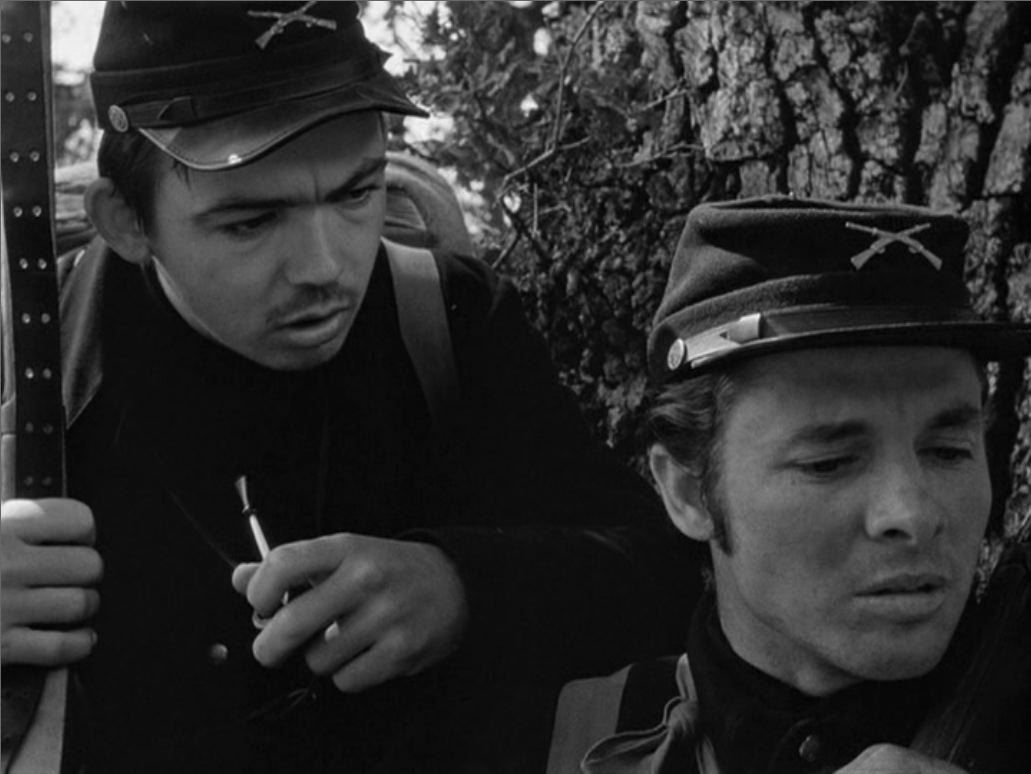
The Red Badge Of Courage (1951)

THE FILM:
In 1950, John Huston happened to read Stephan Crane's famous Civil War novel, The Red Badge Of Courage. He immediately thought it would make a great movie, and brought it to Louis B. Mayor, head of M.G.M. Mayer rejected it on the grounds that it was not commercial, there were no female leads and therefore no love interests (a problem Huston would encounter again when making Moby Dick). However Huston persisted, and this resulted in a bitter power struggle at the studio.

In the end the film was made, but only after Mayer was removed as head of studio. The film was made using mainly unknown actors, including Audie Murphy, the most decorated war hero in American history. It was completed and Huston himself called it his greatest film. He left to Africa shortly after to make The African Queen. However, while Huston was abroad, the studio premiered the film in front of a test audience. They hated it, and the picture was soon in jeopardy.

As Huston was abroad, and the producer was the lone voice that spoke for the film. The studio mercilessly gutted the film, stripping it bare. The running time was slashed in half, and Huston's film was released halfheartedly and forgotten. Huston and Murphy both tried to buy the rights, but the studio said no, and the full version has never been released.

Which is really quite sad, as the film could have very well been Huston's masterpiece.

THE PLOT:
A young Union soldier in the Civil War is getting tired of endless drilling. Finally he gets his wish, as their regiment is told that they are to be shipped out to battle soon. However, the news troubles him. He is afraid that during the fighting he will become scared and run away. He shares his fears with his cocky comrades, but they do little to quell his ever increasing doubts. Finally the next day comes when they all leave for teh battle field.

As they march towards their destiny, the young soldier sees multiple bodies. He finally gets to the battle field, and he doesn't lose his cool during their first skirmish, but when the second wave comes he loses it and runs. Feeling guilty and saddened, he wanders throughout the forest aimlessly, witnessing first hand the gruesome truth of war.

THE CRITICISM:
This film would have been absolutely amazing. If it was it's original length. When I finished the film, I was fuming. Not because I didn't like the film,  but because it was a butchered masterpiece. The studio mercilessly slaughtered the film, with no thought to it's creative integrity. The film lost so much continuity, that they had someone read quotes from the book to maintain some kind of balance. It makes it hard to review this film, not for what is there, but for what could have been. Perhaps someday someone will take control of the film and restore it to greatness (ahem, Criterion).

As it is, I'll focus on reviewing the film as it is. Simply speaking it is one of the best civil war movies of all time. The battle scenes are taught and suspenseful, the acting is top notch and the direction may be some of Huston's best. For starters, Audie Murphy gives a genius performance as the Young Soldier. Having been a war hero himself, Murphy completely immerses himself in the film, and the result is genius. In the earlier parts of the film, his vulnerability is outstanding, and in the later parts of  the film when he rages across a bloody battlefield, the fierce determination in his eyes is stunning.

By casting unknowns, Huston allowed his film to be not distracted by star-power, and relying on performance only. As the Loud Soldier, Bill Mauldin displays the same vulnerability as Murphy, only on the outside, rather than in a contained fury like Murphy. All the actors give a great semblance of realism to the film, something quite striking for a film of the period. I wish to bring up one scene at this moment, the scene in which the Young Soldier meets an older comrade, who is wounded and dying. The scene where he dies is so aesthetically different from the rest of Huston's oeuvre that I found it hard to believe this film was  made by the same man who would later make something so tonally different as The African Queen.

I have not read the novel by Stephen Crane (though I probably should), but from what I've seen I can see why the novel is famous. The screenplay, or what's left of it, is brilliant, and manages to be simplistic while still invigorating. The quality of the version I saw was not the best, but I saw enough of the film to be able to say that the cinematography is amazing. The black and white images contrast the bloodshed in the foreground against the clear gray sky in the background. This sharp, crisp, realistic images are incredibly detailed, especially for the period.

The way the film is shot reminds me of some period war films, and as Huston shot three I can see where the inspiration came from. The battle scenes are, as I said above, simply amazing. They show a brutal reality that few war films dare to attempt. The brutal combat, with an enemy that is never fully shown. Men die right next to you, and yet you carry on, oblivious to why you're fighting, and what you're fighting for. All of this against the clear American sky. It's not hard to see why the film bombed at the box office; it cut to close to the bone.

The score is good, but it can become a bit over the top at times. However, the scenes using traditional music fits perfectly and only enhances the films attitude. This brings me to Huston's direction. Despite my constant criticism's that Huston is lazy, and that he doesn't spend much time on his film's outcome, I have to say that here I am proven incorrect. Huston obviously cared for this film, and he knew it would be special. His meticulous craftsmanship is most easily noticed during the battle scenes.

They resonate with a power no "lazy" director could accomplish. Despite the choppy nature of the 69 minute cut, Huston's calm direction is a constant guiding line throughout. No studio could fumble badly enough to lose the spark that the film contains. This brings me to my problem with the film. It feels incomplete, as if someone took scissors and cut out a bunch of random parts. To make matters worse, the opening narration explaining who Stephen Crane is seems like an attempt to elongate the film.

The running narration throughout is exasperating, as at many points the narrator will interrupt the flow of the film to quote Stephen Crane, while saying something that does absolutely nothing to help the viewer. This is distracting, and with the fact that the film is only 69 minutes makes the film end way too early, and you are left feeling shortchanged.

Overall, this film could have been amazing. As it is, it is only great. It is my hope that someday a restored version will be released, similar to Metropolis. However, as it stands, this is still one of Huston's best, no matter how many people tamper with it.

The Red Badge Of Courage,
1951,
Starring: Audie Murphy, Bill Mauldin and Arthur Hunnicutt,
Directed by John Huston,
8.5/10 (A-)

RANKED:
1. The African Queen
2. The Dead
3. The Man Who Would Be King
4. Moby Dick
5. The Asphalt Jungle

6. The Red Badge Of Courage
7. The Life and Times of Judge Roy Bean
8. The Misfits
9. Beat the Devil
10. Fat City
11. Wise Blood
12. The Treasure of the Sierra Madre
13. The Unforgiven
14. Under The Volcano
15. Heaven Knows, Mr. Allison

16. Annie
17. Prizzi's Honor
18. Phobia: A Descent Into Terror 


Sunday, 20 January 2013

Fat City (1972)

THE FILM:
In the early 1970's, John Huston was right in the middle of what he would later call his "dry period". During this period, which lasted from Sinful Davey to The Mackintosh Man, he would make what he would later call some of his worst films. However, right in the middle of this period was a film that was odd for Huston. It was a critical hit after it's premiere in Cannes, and it's story about boxing and redemption seemed odd for Huston.

The cast was a bunch of unknowns, Huston originally wanted Marlon Brando in the lead, but when that came to nothing he turned to then unknown Stacey Keach. In the role of a young boxer he cast Jeff Bridges, fresh off his debut in The Last Picture Show. He also cast first time actress Candy Clark and Susan Tyrell. The shooting was uneventful and the film was critically praised upon release, but it did nothing commercial, and has faded into somewhat obscurity, which is really too bad, especially for a film that is so interesting for Huston.

THE PLOT: 
Billy Tully is a broken down boxer approaching his thirtieth birthday, and one day he goes to the gym to work out, when he meets Ernie, a young boxer. He tells the boxer to go see his old manager, and he does. Then Billy goes to a bar, where he meets Oma and Earl. Oma is a loud mouth, and she is drunk. Then Billy goes home and Ernie goes to meet Ruben, Billy's old manager. Ruben sees talent in Ernie, and immediately signs him on.

Meanwhile Billy, unable to hold a job, goes out to pick onions, looking for some work. After work, he heads to a bar and meets Oma. Earl has been sent to prison, and she is all alone. They talk for a while and then Billy convinces Oma to let him take her home. They start to live together, and Ernie begins losing fights. Then Billy goes to Ruben, as he has decided he is going to box again.

THE CRITICISM:
This is an unusual film. Up until now, I've always been able to pinpoint Huston's style, maybe it isn't continuous, but usually I can identify a film as a Huston. This is an exception to the rule. When I was watching this film, I could find no link at all to Huston. The closest cousin to this film's style would be an early Scorsese. It is the grittiest of the gritty, and the whole thing sparkles with 70s grime. It feels nothing like a Huston.

In the lead role, Stacey Keach must have known this was his shot, and he plays it like it. His portrait of a down on his luck boxer is intense, especially with his scenes with Susan Tyrell. Their scenes are frighteningly realistic. Keach fills his role with great gusto and life. Billy Tully feels like a real guy, and Keach doesn't make him sympathetic either. No, that job belongs to Jeff Bridges. Bridges is certainly very good, but his character seems very one note.

However, his scenes with Candy Clark are well done, and he is certainly a good actor, but Ernie is really a one note guy. Nicolas Colestano as Ruben is excellent, and his manager is full of life. However, aside from Keach, the film's greatest performance comes from Susan Tyrell. She is excellent as Oma, a bundle of nerves who alienates everyone she loves, it's a great performance. Her scenes with Keach are some of the film's best.

The film was written by Leonard Gardener, adapted from his own novel. The film isn't breaking any new ground with a story of a down on his luck boxer, but Gardener fills his script with enough interesting scenes to keep it from being tired. The score is good, and the opening song sets the mood nicely. Earlier I spoke about the scenes between Keach and Tyrell as being some of the films' best. That is true, but the films best scene is definitely the ending. It speaks volumes without saying much.

The cinematography by Conrad Hall is very spare, shot in brown, dingy hues. It succeeds at showing a world that exists, but no one wants to admit exists. This brings me to Huston's direction. It's very interesting. As I said earlier, the film seems more like it was directed by someone else, but what does that have to say about Huston's direction? Well, for one, it shows exactly how much range Huston had as a director. To compare this to something like The African Queen seems odd, but that they were directed by the same man shows exactly how much talent he had, and how he wouldn't conform to a single genre.

The film is certainly very well made, but it can be hard to watch. I don't quite know how to describe it, other than to say that it just feels too gritty and depressing. It gets hard to watch after a while, until near the end. Then there is the film's subject. It is about boxing, so there are scenes were characters box. To be fair, this isn't exactly Raging Bull, so the boxing scenes aren't outstanding. They are well shot, and because you care about the characters, you have some investment with them, but they go on for a little to long and they could have been cut.

Overall, this is not a bad film at all. It's quite good actually, but it feels draining despite how excellent the performances are. If you feel like a boxing movie, this is one of the best. If you feel like a Huston, this is about how atypical it gets. If you like a good movie, you're on the right track.

Fat City,
1972,
Starring: Stacey Keach, Jeff Bridges and Susan Tyrell,
Directed by John Huston,
7.5/10 (B+)

RANKED:
1. The African Queen
2. The Dead
3. The Man Who Would Be King
4. Moby Dick
5. The Asphalt Jungle
6. The Misfits
7. Beat the Devil
8. Fat City
9. Wise Blood
10. The Treasure of the Sierra Madre
11. The Unforgiven
12. Under The Volcano
13. Heaven Knows, Mr. Allison
14. Prizzi's Honor
15. Phobia: A Descent Into Terror 


Sunday, 13 January 2013

Under The Volcano (1984)

THE FILM:
Under the Volcano is a kind of Don Quixote for filmmakers, that is until 1984. By that I mean, multiple filmmaker's have tried to adapt Malcolm Lowry's 1947 novel, including Ken Russell, Luis Bunuel and Jules Dassin. The novels complicated prose and structure helped all of those ventures collapse. That is until John Huston tried it. He had at least as twelve drafts written, but the novel had proven its legend to be true.

That is, until he had a brainstorm. He thought of the technique he would later use on The Dead. Film it straight, cut the fat, do it literally. The script was written, and Huston headed to Mexico for the third time, to make this film. He had originally wanted to cast Richard Burton as the central character, but Burton was occupied on stage at the time. Huston then turned to Albert Finney, whom he'd worked with on Annie to play the lead.

The shoot was uneventful, and when released reviews were generally kind. The film never made much of an impact, which is odd considering it's source material. This was to be Huston's third last film.

THE PLOT:
Geoffrey Firmin, alcoholic ex-British consul to Mexico, is drunk on the day of the dead in Cuevernica Mexico. His wife has left him, his brother is in Mexico City, and he is lonely. He attends a party, where he gives a drunk nonsensical speech, before going to a bar to drink. It is then that his ex-wife arrives, she misses him, and he misses her.

He invites her back into their home, where they talk, and Geoffrey drinks. His wife, Yvonne, goes to take a bath, and Geoffrey goes off in search of liquor. His brother Hugh arrives and sees Yvonne, he is surprised to see her. Geoffrey comes back, and asks his wife and brother to come with him to see the sights. Geoffrey constantly interrupts their trip with drinking. Eventually, Geoffrey goes on an alcoholic rampage, and Hugh and Yvonne look for him, as night falls on the day of the dead....

THE CRITICISM: 
The entirety of the film rests on one thing, the performance by Albert Finney. Since Huston's shooting method is to utilize no tricky camera positions, or flashbacks, Finney's performance has to knock it out of the park in order to sell this story. And it does. In the history of film, the character of the drunk has always been an interesting one. Overplay it, and it can seem comedic, underplay it and it can seem non-existent. To strike the perfect balance is hard, and with little nifty camera tricks out of the question, the film rests on the actor's performance.

It is generally accepted that the three great dramatic drunk male performances were portrayed by Ray Milland in The Lost Weekend, Nicolas Cage in Leaving Las Vegas, and Jack Lemmon in Days Of Wine and Roses. No offense to any to the above, but Finney blows it out of the water. His Geoffrey Firmin is a force of nature. He is so incredibly into character, that halfway through the film I was not thinking in terms of Albert Finney, but in terms of Geoffrey Firmin.

He delves into the depths of a character that really isn't that likeable, and he doesn't try to make him likeable. He plays it like a real drunkard. When he meets a British man after lying on the road, he gets up and begins to mock the man. The man doesn't know of course, but we do. Finney's drunkenness is done to the tee. When Firmin runs out of alcohol he plows through his typical hiding spots in a rage, until moving into teh backyard, where he find his bottle. It's a bravura performance.

However, Finney is not the only actor who gives a great performance. Jacqueline Bisset, playing Firmin's long suffering wife, gives a wonderful performance. She still loves him, after all of those years, and she thinks she can help him, not knowing he is beyond help. Bisset was quite good in Day For Night, but here she gives a better performance. It's great. The same, however, cannot be said for Anthony Andrews as Hugh Firmin.

To be fair, Andrews isn't given the same opportunities as Finney and Bisset, but his character is kind of bland, so it is hard to create a great character out of this. As Huston lived in Mexico, he certainly knew his surroundings, and the cinematographer strikes a great balance between Firmin's surroundings and his drunkenness.

I do not like the score, although many people do. I find it sounds almost comedic at points, certainly the wrong kind of atmosphere for this kind of film. The screenplay does a great job of condensing an "unfilmable" novel into a film. Huston's direction is laid back, he lets the story take its course, and lets the actors do their thing. I know why Huston would choose to film in such an uninspiring way, but I do wish he could have made his camera just a little more involved.

You can tell he is in control of his film, but it could have been shot in a more involving way. This brings me to my main issue with the film. It is just kind of boring. It moves along at a slow pace, and with characters that are unlikable. This makes it very hard to get into the film. No offense to Huston (or books), the film seems so literary. It never really becomes a film, it feels like an adaptation, all the way down the line.

To be fair, that is Huston's style, but I can usually overlook it, most time I don't even realize it, if the plot is interesting. Here the film feels like a showcase for Finney's amazing performance, with the plot being pushed to the side, much as the novel must have been, with Lowry's thoughts instead of Finney's performance. Overall, this is not a bad film. The performances by the two leads are terrific, and it is a fitting third last film for Huston.

Under the Volcano,
1984,
Starring: Albert Finney,  Jacqueline Bisset and Anthony Andrews,
Directed by John Huston,
7/10 (B)

RANKED:
1. The African Queen
2. The Dead
3. The Man Who Would Be King
4. Moby Dick
5. The Asphalt Jungle
6. The Misfits
7. Beat the Devil
8. Wise Blood
9. The Treasure of the Sierra Madre
10. The Unforgiven
11. Under The Volcano
12. Heaven Knows, Mr. Allison
13. Prizzi's Honor
14. Phobia: A Descent Into Terror

Monday, 19 November 2012

The Dead (1987)

THE FILM:
The Dead was John Huston's last film. He was very sick at the time, and probably knew that his next film would be his last. So when choosing his project, he had to choose wisely. He chose The Dead, an adaptation of the James Joyce short story. It was very much a family affair, with his son Tony writing the screenplay and daughter Angelica playing the female lead. It was during the making of the film that his health deteriorated.

He died four months before it was released, and during the film making he suffered innumerable challenges. He relied on an oxygen tank to breath, and he couldn't go 20 minutes without it. Sometimes Huston would get stuck in his car, and be unable to get to the stage, and he would have to relay direction through his assistants. Despite these challenges, Huston made the film, based off a supposedly  "un-filmable" story. It was only after multiple revisions that Huston found the right approach, and with it, one of his finest films.

THE PLOT:
Greta and Gabriel Conroy are married, and they like each other, in turn of the century Ireland. They go to a party being held by three spinsters on January the 6th. After the party, they return to their hotel. That is the plot, seriously, that's it. To go into more detail would be frivolous without critical commentary, so that brings me to it.

THE CRITICISM:
The Dead is without a doubt the finest last film of any director with a sizable body of work, that I have seen. What Huston accomplishes in 72 minutes is what most filmmakers try their whole careers to accomplish. The film is so simple, yet its simplicity is its finest asset. Huston here manages to try something new, and for a man in his 80s, who is dying, that is quite a risk. And he pulls it off, of course. Some directors, like Hitchcock and Wilder have tried this approach, and the results aren't generally amazing.

If you read the plot, you'll see that the film's plot is quite thin, I could sum it up in five seconds, so Huston relies on characters and mood to set it up. In order to do that you need two things: good actors and a good script. And he has both. Some might say that The Dead was an act of nepotism, and yes, Huston draws on his family. John cast Anjelica in three of his films, and under his direction she won an Oscar. Here she gives a performance that doesn't seem to amount to much, for the first hour.

Then, near the end, she is walking down the stairs when a tenor from the second floor begins to belt out a tune. I can't name it, but she stops and closes her eyes, swaying gently to the sound of his singing, almost in a trance. Then she goes home and tells her husband of a past lover, who came to her one night, having suffered a terrible sickness. He died, and she believes that she caused him to die, wandering in the rain. But I'm, getting ahead of myself.

The performances, Huston (Anjelica, that is) is absolutely terrific. She puts up a facade for the first hour, but then she slowly lets it slip, and you glimpse her. Donal McCann is absolutely terrific in the role of Gabriel, her husband. I hadn't heard of him before this film, and its a shame, his ending monologue is close to perfection. The supporting cast is flawless, consisting mainly of people that I hadn't heard of before, which helps you to believe that they are their respective characters.

The screenplay does the wonder of turning what has been called the greatest short story of all time into a motion picture. Tony Huston is more than up to the challenge. It has been said that John Huston had been trying to get the film made for some time, but he couldn't find the right approach, and one day it came to him. The story doesn't need to be jazzed up with flashbacks and unnecessary additions. The best way to adapt the short story is to just tell the story.

No embellishes, nothing. Tell it straight. It works. I haven't read the source material, but I want to now, based on the final scene alone. The score perfectly complements the film, striking a melancholy but optimistic chord. Indeed some of the lengthy dialogue scenes can be frustrating, especially when they harp on singing and turn of the century Irish-British relations, but for some reason you are still compelled. I feel that what really makes the film work are the characters.

They feel real. They feel like people you know, from Freddie the pathetic drunk, to Greta, the "perfect" woman. They don't beg any stretch of the imagination. The whole party reminds you of past experiences and perhaps with a hint of nostalgia. Then I bring you to the direction. In his last film, John Huston managed to create a truly awesome film experience. It doesn't have any explosions, or detectives, greedy prospectors or riverboat captains. It has real people.

Huston manages to weave his camera through a scene so well, that it makes you feel that you are almost eavesdropping on someone else's party. By the end, you almost feel as if you know these people, and in a way you do. As the crisp snow falls on a forgotten Irish graveyard, we are reminded that we are all alive, but then we die, and time will pass us by. That brings me to my final comment: the title. It is perfect. It sounds as if the film is a horror film, but it is truly about the passage of time, how the dead can haunt the living from beyond the grave, but not in a scary way.

The dead hold a power over the living no matter how old and wise you are. They still cast a shadow over our lives, and we remember them until, perhaps, we join them. I debated giving this film a 9.5, but my sentimental side won over my few small problems. I'll end this review by quoting from the last narration, a fitting end to a terrific film.

"Like everything around me, this solid world itself which they reared and lived in, is dwindling and dissolving. Snow is falling. Falling in that lonely churchyard where Michael Furey lies buried. Falling faintly through the universe and faintly falling, like the descent of their last end, upon all the living, and the dead."

The Dead,
1987,
Starring: Anjelica Huston, Donal McCann and Donal Donelly
Directed by John Huston,
10/10 (A+)

RANKED:
1. The Dead
2. The Asphalt Jungle
3. The Misfits
4. The Treasure of the Sierra Madre
5. Heaven Knows, Mr. Allison

Monday, 5 November 2012

The Asphalt Jungle (1950)

THE FILM:
1950. John Huston isn't exactly "hot stuff". His new project has no big name actors, and a plot that could have depressed anyone. It is about a bank robbery, and it's after effects. Not exactly box-office gold. Another problem. Star Sterling Hayden was a communist, and both him and Huston are on The Committee for the First Amendment. It seemed as if the studio just wanted to see what would happen. Good think Huston pulled it off.

THE PLOT:
"Doc" Riedenschnieder has just been released from prison. He is considered one of the foremost criminal masterminds of the time.Immediately after his release he is itching to pull of another heist, his last. Then he plans to retire to Mexico, he recruits heavy Dix. It's a Jewellery store robbery, and he knows he can do it, he just needs someone who will be able to sell the Jewels after the Robbery. He turns to Emmerich, a rich family man, who runs little things on the side, like having an affair with a beautiful blonde.

Unfortunately for Doc, Emmerich plans to double-cross him after the heist, and Doc knows it, but he goes on anyways. He recruits some other men, and at the same time Dix finds himself in a relationship with a woman whom he doesn't love, but who is devoted to him. SPOILERS. The heist doesn't come off the way Doc planned and he is faced with multiple double crosses and the cops on his trail. In other words, it's a typical Noir.

THE CRITICISM:
 John Huston was born for Noir. He defined the genre with The Maltese Falcon, and his sharp wit and attention to detail was a perfect match to that film's sharp and direct dialogue. Here he works in the genre, but not in the tradition of films like The Big Sleep or Falcon, where there is some happiness. No, here no one is happy. They are greedy and selfish, and perhaps only Jean Hagen is the only non-cynical character, yet even she has an unhealthy selfish desire to nurture, to love Dix.

There is no hope in The Asphalt Jungle, it is one of the most depressing things I've ever seen. It is also one of the most realistic films ever to come out of Hollywood. The gritty, hopeless city presented here could be any major city in the US. New York, Los Angeles, Miami, it could be set in any of those. These characters have been rotting from the inside out, and their insatiable greed and lust can only lead to their destruction.

Yet you feel sorrow, you want them to have some kind of happy ending, and that is one thing that these people will never have. That brings me to the performances, uniformly excellent. Huston had a great knack for getting great performances out of actors, and this is no exception. Hayden has always been a unique actor. On his face is etched the pain and suffering of thirty odd years in the crime racket. You get the sense that he is running on fumes.

Hagen is, as I mentioned above terrific, she is one-minded in her obsession with Dix. Louis Calhern is slimy and, despite his good-guy act, he is rotting from the inside. His affair with Marilyn Monroe is just a way for him to embrace his true slimy nature. When he is questioned by the police, you can see him desperately trying to get himself out of the situation, lying until he can lie no more.

Also good is Sam Jaffe as Doc and James Whitmore. The film barely has a score, which may be due to artistic intent or laziness, but the lack of score reinforces the gritty reality of the film. The cinematography is amazing, delving in the shadows and murky depths that define Noir.

And finally the direction. As I mentioned above, Huston keeps it realistic, with little to no artistic flourishes, and it works completely. Huston was the perfect match for the material, and it certainly pays off.

The Asphalt Jungle,
1950,
Starring: Sterling Hayden, Jean Hagen and Louis Calhern
Directed by John Huston
9/10 (A)

RANKED:
1. The Asphalt Jungle
2. The Misfits
3. The Treasure of the Sierra Madre


Tuesday, 16 October 2012

The Misfits (1961)

 THE FILM:
Made in 1960-1961, The Misfits is a very unique production. It was both Clark Gable and Marilyn Monroe's last completed film. It was written especially for Monroe, by her last husband Arthur Miller, at the end of their marriage. It also starred Montgomery Clift, who was notoriously unstable following his car accident, and relatively unknown character actor Eli Wallach. Perhaps the only stable part was Thelma Ritter, a well-known, reliable character actor. Even the director, John Huston, was a wild card. The production seemed doomed.

THE PLOT:
The Misfits opens in Reno, Nevada, where young divorcee Roslyn is staying, while waiting for her divorce to come through. She is with her friend, Isabelle, and they stop in a cafe. There, they meet Gay Langland, a cowboy who has seen better times. Roslyn decides, in the spur of the moment, to accompany Gay to his ranch, in the desert.

To avoid giving away too much, I'll describe the rest of the plot in much broader strokes. They spend the rest of the film mainly in the desert, where we also meet Guido, a younger ranch hand, with an instant infatuation to Roslyn. The film also includes Pierce, a Rodeo man, who's gone way past his prime, but continues despite this.

THE CRITICISM:
I`ll begin with the actors. Marilyn Monroe was not a great actress, but she fit certain roles. This was not a `typical` Monroe role, but she does well. I can`t help but feel that her performance was desperate, and it works well at times, while failing at others. It is an average performance, but it certainly ranks among her greatest. However the main acting achievement on display here, was that of Clark Gable, in his last performance.

Gable was always cast as a matinee idol, and he indeed has great looks and a wonderful screen personality. Unfortunately, he always played the same character, almost. Even Gone With the Wind dosen`t fully break the mold. Here, from the start, it`s something different. The charm and wit are still there, but buried underneath are layers of sadness. You get a sense that his time is passed, and he can`t cope. The scene that shows this best, is when Gable, elated at seeing his kids, comes back to bring Roslyn to see them.

They`ve already left, and he breaks down in drunken agony. It`s his best performance. Also we have Thelma Ritter, bringing her usual amount of wit and pathos to the film. Eli Wallach is very slimy and completely one-minded in his obsession for Roslyn. Montgomery Clift is unstable and shaky, playing an unstable and shaky rodeo clown. It`s his last great performance.

Now to the writing. It is not Arthur Miller`s best, he wrote it with the purpose to provide his wife with a good role. The plot is interesting however, and the film itself is well done, so this is not a major problem. The cinematography is equally as desolate, and captures the feeling of time lost, and a world that has moved on, and left you behind. Now, for my last criticism, I turn to the direction.

Here, Huston tones it down slightly, and gives us a more subdued film, which is perfect for the subject. He was really a man who knew when to make his film experimental, and when to make it conventional. Here he goes the safe route, while still retaining the beauty of a film about loss. It works. In Huston`s career, this may rank as a minor achievement, but the talent on display is undeniable. It is a beautiful film, that ends with one of the most moving moments in Huston`s entire catalog. I`m going to describe that moment now, so I put up a big SPOILER alert.

Gable and Monroe are driving home, they have found love in a strange way, but Monroe wants to know if they`re going in the right direction. (I copy of IMDb`s quote section).
[Last lines]
Roslyn: Which way is home?
Gay: God bless you girl.
Roslyn: How do you find your way back in the dark?
Gay: Just head for that big star straight on. The highway's under it. It'll take us right home.

That`s pretty much all I have to say.

The Misfits,
1961,
Starring: Clark Gable, Marilyn Monroe and Montgomery Clift.
Directed by: John Huston
8.5 out of 10 (A-)

RANKED:
1. The Misfits