Showing posts with label enjoyable. Show all posts

Friday, 8 August 2014

Moulin Rouge (1952)

"WELL, GEE, I WONDER WHAT WE CAN DO TO JOSE FERRER NEXT?"

This is a quasi-musical effort, featuring everything that defines those classic pictures, from lavish costumes to other-worldly lighting, directed by a man who's name is about as far away from the genre as you could hope for. Indeed John Huston, the man behind such pretty and frothy films such as... Annie and The Treasure of the Sierra Madre, may not have been my first guess as the helmer of a film like Moulin Rouge, but to my surprise, the result isn't half bad. Of course, there are pacing issues, the montages of Toulouse-Lautrec's run on for far too long and Zsa Zsa Gabor's (dubbed) singing voice is incredibly harsh and grating.

But, I am happy to say, those few things comprise the bulk of my criticisms. So, let's move on to the good stuff. The best part of Moulin Rouge is the art that went into it. Every costume is opulently decorated, while all the sets nearly pop out of their walls with exuberance. The film uses the streets of Paris and the carefully decorated sets of Shepperton Studios to create an atmosphere that embodies the period perfectly (though with almost more reverence for the era than I have seen in quite a while). Indeed, from Ferrer's apartment to the dancing halls of the Moulin Rouge itself, every set seems carefully thought out and planned to the highest degree.

This reverence for decoration is perfectly translated towards the clothing aspect of the film's characters. From the creative dressing shirts which accompany the different male characters, to the sumptuous dresses which seemingly keep getting better and better the further into the film progresses. I normally pay no mind to this aspect of filmmaking, but the sheer quality on display here struck me more than it ever has. For a film revolving around the life of an artist, to see him surrounded by such art (albeit of a different medium) is quite the fitting tribute.

But, ah, I'm getting ahead of myself, aren't I? I haven't told you the plot yet! Okay, here we go. Moulin Rouge is the story of Henri de Toulouse-Lautrec, a painter in Paris around the turn of the century. As a child, he was poised to inherit his father's noble title, until an accident led to him breaking both of his legs. Misfortune follows him yet further as his legs are unable to grow, and he is left disabled. This disability has left him seemingly shunned from romance, until he meets tempestuous Marie Charlet, an impoverished woman of the streets. He protects her from the police, and then falls in love with her. Despite her seemingly loving him back, her destructive nature and alcoholism drives them apart. Will they find a way to stay together, or will Henri follow a path of addiction and heartbreak?

The standout performance in the film belongs to Colette Marchand as Charlet. Her cooing voice and mannerisms make her instantly endearing, and gives the viewer quite the whiplash when she goes on one of her mood swings. Despite some over the top moments later on in the film, her first few scenes are a masterclass in acting, and they serve to bring the (up until that point) frigid Jose Ferrer out of his shell. Ferrer is, unfortunately, bland for much of Moulin Rouge, only really coming to life in various pockets of the film. Zsa Zsa Gabor is a touch annoying, though her arc does have undeniable merit, and Suzanne Flon gives life to a mostly thankless supporting role.

Now, I'd like to take a second to talk about lighting. Every now and again, I'll be watching a film, and suddenly a streak of light, perhaps a slightly different shade of green, will flash across the screen and leave me breathless. It doesn't happen often, but when it does I really begin to get into the film, at a much higher level. It is a way of having atmosphere just roll off the screen and into my eyes, and a way for me to appreciate what I'm seeing more than I could have ever possibly otherwise. That happened to me during Moulin Rouge, and that subtle shift in lighting got me more intrigued by the film than anything else could have. I know, it's strange.

Moving on then, the cinematography is the kind of exuberant Technicolor that you really don't see anymore. It renders every frame with a kind of dreamlike (almost as if the images were coloured with pastels) air, and it makes it much easier to accept the "studio" touches. The score has fits of harmony, but is for the most part discordant with what is happening on the screen. The special effects employed to make Jose Ferrer much shorter than he is in real life are a tad rough, but they accomplish what they are tasked to.

But, and this was to both my surprise and my delight, the ending is perhaps the best part of the film. Without giving anything away, I must say that I was expecting to see a typical "studio ending" where everyone lives happily ever after, and so I was dumbstruck by how casually and slyly Huston slid in the actual ending. It's a knockout, in terms of impact and guts, as I'm sure at least a few producers grew red with anger when they saw the final print. It's also the perfect ending for the material, and I must applaud whoever wrote it for sticking with it.

And so, despite my initial reservations, Huston's direction is quite nice here. It accomplishes what must be done with enough style to keep you interested. You can really tell he was enjoying breaking his mold by making this film, and it shows. It's not perhaps his best film, but it's a very solid entry into an increasingly solid filmography.

Moulin Rouge,
1952,
Starring: Jose Ferrer, Colette Marchand and Suzanne Flon,
Directed by John Huston,
6.5/10 (B-)

RANKED:
1. The African Queen
2. The Dead
3. The Man Who Would Be King
4. Moby Dick
5. The Asphalt Jungle
6. The Red Badge Of Courage
7. The Night Of The Iguana
8. Key Largo
9. The Life and Times of Judge Roy Bean
10. The Misfits
11. Beat the Devil
12. Reflections in a Golden Eye
13. Fat City
14. Victory
15. Moulin Rouge
16. Wise Blood
17. The Treasure of the Sierra Madre
18. Under The Volcano
19. The Unforgiven
20. Across the Pacific
21. Heaven Knows, Mr. Allison
22. The List of Adrian Messenger
23. Annie
24. Prizzi's Honor
25. The Barbarian and the Geisha
26. The MacKintosh Man
27. Sinful Davey
28. In This Our Life
29. We Were Strangers
30. The Bible: In The Beginning...
31. The Roots of Heaven
32. Phobia: A Descent Into Terror

Monday, 21 July 2014

Across the Pacific (1942)

*I apologize for my extended absence, but I'm back now. So, take that positively I hope!*

"MINE IS BIGGER THAN YOURS"

Yes, that may very well be a euphemism, but not one of my doing I can assure you. It comes from a scene in 1942's Across the Pacific where Humphrey Bogart is sizing up his revolver in comparison with Sydney Greenstreet's. I'll leave it to you to discover who's was bigger, but, needless to say, both men found it necessary to rely on their guns in the very near future.

This film was John Huston's second time working with Humphrey Bogart, after their highly successful prior pairing on The Maltese Falcon. It seems as if Warner Brothers wanted some more of that magic, because they brought back Mary Astor and Sydney Greenstreet along with Bogart and Huston (sadly, Peter Lorre could not make it to the reunion). In an oddly prophetic twist of fate, when the film was originally put into production it revolved around a Japanese attack on Pearl Harbor, which Humphrey Bogart was to thwart. Unfortunately, when the Japanese actually attacked Pearl Harbor, it necessitated a move of location to the Panama Canal (though, apparently, the title had no reason to be changed and remains absurd as they never get to the Pacific Ocean).

The war also had unintended consequences as it meant that, like so many other Americans of the period, John Huston was caught in a wave of patriotic duty and joined the army. Leaving halfway through shooting the film's climactic chase, Huston's replacement Vincent Sherman asked how Bogart could possibly escape such a situation, and Huston remarked something along the lines of "I have no idea, your problem now!" But what exactly does Humphrey Bogart have to do "Across the Pacific"? Well, the plot revolves around Bogart's character Rick Blaine, ah sorry, Rick Leland, being dishonorably discharged from the army. After a failed attempt to join the Canadian forces, the bitter Leland decides to offer his services to anyone who can may, and boards a steamer headed for the Orient.

On board he meets both the enigmatic Dr. Lorenz (Greenstreet) and the alluring Alberta Marlow (you'll never guess where she comes from. Wait for it... Alberta! Who saw that one coming?), played by Mary Astor. Leland naturally becomes enamored with the seductive Marlow, and they begin a romance. But yet, the Doctor begins to appear more and more like a Japanese sympathizer, climaxing in a scene where he offers Bogart money for secret navy information. Bogart is on the fence, and just as it looks like our intrepid hero might be crossing over to the dark side, it turns out he is an American spy! Can this one dashing hero save the Panama Canal from a nefarious Japanese attack?

Well, I won't tell you that until you've seen it of course! There are two things that concerned me before watching this one. First: that it would be a simple generic patriotic action film and second: that there would be some offensive Japanese stereotypes included in the mix. On the first count, I was not wrong. In many ways, Across the Pacific is similar to Michael Powell and Emeric Pressburger's Contraband. Both films feature a dashing hero, a morally grey female love interest and a group of Axis sympathizers plotting an attack. Both are undoubtedly fun features, with some excellent dialogue and suspense in both, but they're really nothing special in the end.

On the second count, I was pleasantly surprised. There were only two lines in the film when I detected any outwards racism, and neither of them detracted from my opinion of the film much, other than me having to stifle a giggle over how ridiculous they sounded in the mouth of Bogart and Astor. For the most part, the Japanese are treated just as the Germans were in Contraband. Nefarious, evil, scheming bastards they may be, but it has very little to do with the colour of their skin. Such politics are refreshing in such an otherwise generic experience.

Another positive note I took from my viewing was the chemistry between Astor and Bogart. During The Maltese Falcon, there was always an icy edge to their banter. Here, it's a lot more playful, and the film is better for it. Both Astor and Bogart get to sneak in some simply beautifully constructed barbs at each other, and despite Astor's typical turn into the helpless female by the end, her integrity and singularity from the first two scenes is impeccably preserved.

Bogart too is in fine form. He has a tendency to phone in his performances sometimes, but here he's perfectly involved in the plot and it makes watching the film much easier because his commitment shines through to the viewer. Sydney Greenstreet's wonderful voice is well suited for the many scenes he shares with Bogart, and his last scene is actually rather tragic in a heart breaking way, which had Huston not been, well, fighting in a war, the camera may have captured in a more interesting way than the format Vincent Sherman had in mind.

Sen Young is a bit annoying as a supporting passenger on the cruise only because most of his scenes involve breaking up Astor and Bogart, who are such a joy to watch on their own. Seeing Don Siegal's name in the credits is a bit of a surprise, but I suppose doing the "montage" (as he is credited for) must be as hard a job as any other. Speak of the devil, the editing is rather good in this film, and so are the "montages". Bogart's costume must have been reused for Casablanca because it looks exactly like the hat/suit/overcoat combination he wore in that film's famous climax. It also doesn't help that his character's name is Rick or that Alberta's (I seriously can't get over that) last name is Marlow. Foreshadowing Pearl Harbor is creepy enough, but foreshadowing both of Bogart's most famous future characters? That's just incredible.

The cinematography dips into the luscious world of shadows that black and white portrays so well. Many scenes, such as those at night, are fantastically photographed. And yet, even despite his departure, the film is well directed by Huston. His relaxed style is very helpful as it takes ones eye off the the filmmaking and onto the story which, although cliched and generic, is still interesting. You can tell he must have been having fun on set because, for the most part, the film flows so well. It's not his best work, but it seems like a great job in any case.

And that pretty much sums up Across the Pacific in a nutshell. It's fun, interesting and involving, but it's also generic, cliched and half baked. Take what you will from it, but at least it's a good ride.

Across the Pacific,
1942,
Starring: Humphrey Bogart Mary Astor and Sydney Greenstreet,
Directed by John Huston,
6/10 (C).

RANKED (This list has been readjusted since last seen):
1. The African Queen
2. The Dead
3. The Man Who Would Be King
4. Moby Dick
5. The Asphalt Jungle
6. The Red Badge Of Courage
7. The Night Of The Iguana
8. Key Largo
9. The Life and Times of Judge Roy Bean
10. The Misfits
11. Beat the Devil
12. Reflections in a Golden Eye
13. Fat City
14. Victory
15. Wise Blood
16. The Treasure of the Sierra Madre
17. Under The Volcano
18. The Unforgiven
19. Across the Pacific
20. Heaven Knows, Mr. Allison

21. The List of Adrian Messenger
22. Annie
23. Prizzi's Honor
24. The Barbarian and the Geisha 
25. The MacKintosh Man
26. Sinful Davey 
27. In This Our Life
28. We Were Strangers
29. The Bible: In The Beginning...
30. Phobia: A Descent Into Terror  

Saturday, 6 April 2013

Sinful Davey (1969)

THE FILM:
Sinful Davey would mark the beginning of John Huston's so called "dry" period. This period, which in Huston's eyes, would last from 1969 to 1975. He made many of his worst films during this area, and he blamed his decline on this film. It was basically forgotten after release, spending only a week in theaters. I had a devil of a time locating this film, eventually finding it on a limited release bare bones edition by MGM. The package it came in is so amateurish, I though in the beginning I was being duped. Anyways, there is a reason this film is little known. It was released six years after Tom Jones, and was generally thought to be a "rip-off" of that film.

The film cast a young John Hurt, ten years before he would break through in Alien and The Elephant Man, as the lead. The cast was filled out by a couple promising young actors and actresses, and Robert Morley, whom Huston had worked with on Beat the Devil and The African Queen. Huston had originally wanted to cast his daughter Anjelica in the lead female role. The producer disagreed, as Anjelica had only appeared in Huston's A Walk With Love and Death up until this point. Huston eventually agreed on Pamela Franklin, but this caused a rift between producer and director, a rift that widened even more when Huston refused to re-edit the film.

Today, where does this film stand? It has a 5.8 on IMDb (that's bad), and 33% on Rotten Tomatoes (also quite bad), and it is barely remembered, if at all. It is one of Huston's most forgotten films, and there's a reason for that....

THE PLOT:
Davey Haggart is a drummer in the British Army. One day, he deserts the army, and begins a life of crime. Davey is inspired by a man who may or may not be his father, an infamous criminal. Davey sets out to up his father, by committing the exact same crimes as him. He does this by dressing up as a Duke, and integrating himself into high society, while conspiring with a fellow pickpocket to rob the same Duke his father robbed. A small wrench is thrown into Davey's plans when Annie, a girl whom he befriended in his youth, is dead set on reforming Davey.

Annie also harbors a great love for Davey, an affection he does not return to her. While Davey seems to end up in bed with every girl he meets, he is still completely ignorant to Annie's love. Can Annie reform Davey before he suffers the same fate as his father, death by hanging?

THE CRITICISM:
....It's not very interesting. It's just an average film, through and through. There's nothing really special going on here, just your typical adventure film. The performances, direction, script, all are perfectly average, and they never excel beyond expectations. This isn't a bad film, but it isn't very good either. As Huston stated himself, it feels very dry. Some parts are exciting, and entertaining enough to light a smile on your face, but nothing here indicates any kind of genius whatsoever.

The best part is easily John Hurt. Hurt is a great actor, and he proves here that he charisma to spare, and was a great lead actor all the same. It's the kind of part that requires little acting, but heaps of presence. Despite being virtually unknown at the time, Hurt acts like he owns the place, and as a result totally owns the character of Davey Haggart. With a better script and director, this could have easily been awesome. However, we do get a glimpse of what could have been through Hurt. Despite the film itself, he excels. I could have easily watched just Hurt going around the country robbing people. That would have been a movie.

The rest of the cast is uniformly blah. We never really care for many of the characters, and the film's light tone makes it hard for us to really feel any stakes towards Davey's fate. Pamela Franklin is the wide-eyed do-gooder who tries to save Davey's soul. Every time she's on screen I checked my watch. She's just not that interesting, and her character's mission doesn't make much sense. I watched the film an hour ago, and she's already began to fade from memory. The rest of the cast, Robert Morley, Nigel Davenport and Ronald Fraser make little impact on the viewer and are easily forgotten, as is most of the movie.

I can't really offer any suggestions as to what would have made the casting better, but I can definitely describe what could have been done to improve the script. Make. It. Darker. I understand why the film wanted to be "light", it appeals to more people. But there is just no sense of danger here at all. Davey's escapades are very entertaining, but with a little malice, or stakes, they could have been much more interesting than what they are. The film feels very "cute", it never really wants to be more than it is. It is in that respect, one of Huston's most sincere films. However, sincerity doesn't equal a good film this time around.

The cinematography is certainly very pretty to look at, although the transfer to home video is very poor, rendering everything looking mute and dull. The film's locations are very nice indeed, and some of the scenes of John Hurt robbing people at a ball are very inventive and help to further the comedy of the situation. the score is rather unremarkable but it, along with the opening song are still quite effective within the movie itself, often helping with the light tone.

The direction is quite typical of Huston, it feels relaxed as if he is just letting the story take place at it's own pace.  It does help that the film has a relatively short running time. At 95 minutes, it certainly does not feel overlong. It could have benefited from a director who was more in tune with what he wanted from the film, but I can't bash Huston's direction completely, as there is nothing that really stands out as awful. There is also, however, nothing that stands out as good either, quite indicative of the film itself.

Overall, is Sinful Davey bad? No. Is it good? Not really. What it is is an hour and a half of John Hurt running around Scotland. You could do worse.

Sinful Davey,
1969,
Starring: John Hurt, Pamela Franklin and Robert Morley,
Directed by John Huston.
6/10 (C-)

RANKED:
1. The African Queen
2. The Dead
3. The Man Who Would Be King
4. Moby Dick
5. The Asphalt Jungle

6. The Red Badge Of Courage
7. The Night Of The Iguana
8. Key Largo
9. The Life and Times of Judge Roy Bean
10. The Misfits

11. Beat the Devil

12. Reflections in a Golden Eye
13. Fat City
14. Wise Blood
15. The Treasure of the Sierra Madre
16. The Unforgiven
17. Under The Volcano
18. Heaven Knows, Mr. Allison

19. Victory
20. The List of Adrian Messenger
21. Annie
22. Prizzi's Honor

23. The MacKintosh Man
24. Sinful Davey
24. We Were Strangers
25. Phobia: A Descent Into Terror

Saturday, 23 March 2013

Victory (1981)

THE FILM:
John Huston was nearing the end of his life. Having just finished the under seen, horrifically bad Phobia, he set his eyes on a project that looked incredibly commercial. It was the story of an allied soccer team who played Germany to escape. Having originally been written as a drama, the project Huston overtook was fluff. However, it was commercial fluff, and Huston was short on cash. The film was to star Michael Caine, Sylvester Stallone and Brazilian soccer player Pele.

As soon as filming began, it became clear that Stallone had the biggest ego on set, through his insistence that he score a goal, despite being the goalkeeper (that's impossible in soccer). The film went on to become a modest hit, grossing close to $11 million, and it soon disappeared. Today the film is mostly found in bargain bins and double disks with similar films. It has a 6.4 on IMDb, and a 67% on Rotten Tomatoes. It is essentially a product of it's time, but that doesn't mean it is without perks.

THE PLOT:
We are introduced to Captain Robert Hatch and Captain John Colby, an American and a British officer stuck in a German prison camp in World War II. Colby was once a famous football (soccer) star back before the war. He holds a mutual admiration for Major Karl von Steiner, a former player, and now a German officer. Steiner sees a possible propaganda victory in a soccer team run by Colby, and challenges him to a friendly match. Colby agrees, while the officers around him try and convince him to escape sometime during the game.

It is after Hatch escapes and returns with the knowledge of a way out of the change room during halftime, Colby agrees to get him, and his ragtag team of soccer stars, out. But can they leave victorious as well...

THE CRITICISM:
My first thought when I heard of Victory was, "Wow, that sounds campy." After I saw it, I though "Wow, that was campy." As soon as you see Michael Caine and Max von Sydow as two former soccer stars, you can pretty much give up all hope for a serious film. Although that doesn't mean Huston doesn't try. Or at least he appears to try. Everyone involved takes it so seriously, it's actually kind of funny. There are points where you just start laughing at the absolute absurdity of the situation.

I mean really...a soccer game? The fate of World War Two depends on a soccer game? Well, according to this film it does. And the soccer game is so bad, it's actually entertaining. Don't get me wrong, I am not a huge fan of soccer, but I know that no soccer game can have as many absurd kicks and slow motion goalkeeping while someone yells "Victory!" in the background. The soccer game is so cheesy, that it instantly becomes memorable. That is not to say that the film proceeding it hasn't the same absurd perks.

The opening hour is pretty much just a setup for the big game, with Michael Caine doing a lot of running and shouting while Sylvester Stallone breaks out of prison from the shower. I mean, really... And I'm not even going to mention the ending, which is so implausible that even a six year old could have said "That's impossible!" Stallone could be considered to be the main character, I guess (he is billed first). He does an adequate job, but I have trouble believing that the bulky Stallone and the potbellied Caine are starving POW's. Stallone gets the bulk of the film's most dramatic scenes, which isn't a bad decision, but this is an action film.

At times it appears that Stallone is having a hard time deciding what his character is all about, while reading his lines in the same tone. He can really dive for a ball in slow motion though... Caine, when contrasted with Stallone seems like he's doing Shakespeare. He gives the best performance of the film (meaning he doesn't suck), while actually giving, gasp!, depth to his performance. Caine has always been a great actor, but he still didn't catch onto the campiness of the film, so he plays it straight. This makes it even cheesier, thus making it more entertaining.

There is another actor involved who gives an average performance, Max von Sydow. Von Sydow has always been a great actor, and he may have been the only actor in on the joke. He also portrays the nicest doggone Nazi I've ever seen. He just isn't threatening, but he is entertaining. After Pele gives a slow motion bicycle kick, he stands up and claps with absolute reverence. Oh, and Pele plays for the opposite team than the one he is supposed to cheer for. Just thinking about that moment has me in stitches.

Speaking of Pele, most of the cast is made up of famous soccer players. Besides Pele, who is largely considered one of the greatest soccer players of all time, the film also features Bobby Moore, Osvaldo Ardiles and so on. They all perform greatly on the field, as they do a lot of kicking, and yelling at Germans. The script is an absolute mess, yet it is such an entertaining mess! It walks the thin line between bad and average skillfully.

The cinematography is nothing to write home about, but I must pay tribute to Bill Conti's bombastic score. It is overly patriotic in the best way possible, in someways foreshadowing his terrific score to The Right Stuff. Also bombastic are the sets, particularly the stadium where the pivotal game is played, and contribute to the over the top nature of the film.

And that about brings me to Huston's direction. I know that he was nearing the end of his life, but this film is so lifeless, so devoid of direction, that you could have literally changed the directorial credit to anyone else, and I would have believed it. I do not mean to harp on the same point in every one of these reviews, but it is so frustrating that the film is so languid and relaxed direction wise, it gets me every time. Overall, this film is so bad, it is incredibly entertaining. In a campy sort of way, you could call it a success, but as a film it is definitely lacking.

Oh, and by the way, at one point Sylvester Stallone speaks french. Just thought I'd leave you with that thought.

Victory,
1981,
Starring: Michael Caine, Sylvester Stallone and Max von Sydow,
Directed by John Huston,
6.5/10 (C+)

RANKED:
1. The African Queen
2. The Dead
3. The Man Who Would Be King
4. Moby Dick
5. The Asphalt Jungle

6. The Red Badge Of Courage
7. The Night Of The Iguana
8. Key Largo
9. The Life and Times of Judge Roy Bean
10. The Misfits

11. Beat the Devil

12. Reflections in a Golden Eye
13. Fat City
14. Wise Blood
15. The Treasure of the Sierra Madre
16. The Unforgiven
17. Under The Volcano
18. Heaven Knows, Mr. Allison

19. Victory
20. The List of Adrian Messenger
21. Annie
22. Prizzi's Honor

23. The MacKintosh Man
24. We Were Strangers
25. Phobia: A Descent Into Terror


Sunday, 17 February 2013

Key Largo (1948)

THE FILM:
After World War II, John Huston was eager to get back into the business. After The Treasure of the Sierra Madre, Huston came upon Maxwell Anderson's play Key Largo. He decided to do it, but only after completely rewriting the entire play. After completing the script, he went to the studio and, contrasting with Sierra Madre, he shot it entirely within the studio.  The film featured a cast of Hollywood heavyweights, including Humphrey Bogart, Edward G. Robinson and Lionel Barrymore.

Despite the fact that it was well received, the film has faded into relative obscurity. It won an Oscar for Claire Trevor, but that was the extent of it's awards. This is really quite sad, as it is excellent.

THE PLOT:
Ex-Army Major Frank McCloud travels down to Key Largo, in order to pay his respects to the family of one of his fallen comrades. When he gets there, the hotel they run is being inhabited by city men of the shady kind. He gets a drink from a woman at the bar, and then goes out to meet the family. At the same time, the hotel receives a storm warning, a hurricane is on the way. They shut up the hotel, and then it is revealed that the shady men are working for Johnny Rocco.

Rocco was a Prohibition era gangster, and he is in Key Largo to collect a payment. As the hurricane comes and the characters are all trapped under the same roof, danger ensues.

THE CRITICISM:
If Hollywood was good for one thing in the 1940s, it was making films like this. This kind of adventure film speaks to the masses, while still managing to entertain. This was the kind of action film you got back then, except less action and more buildup and talking. This is the kind of film they don't make anymore, and the kind I wish they did. A film like this doesn't need a good director, or a good plot, just good actors and great dialogue. This film has all of the above.

The acting is consistently excellent. Humphrey Bogart plays his typical stoic hero, but that's okay because the part never gets old. Lauren Bacall does good work as the widow of Bogart's old army buddy, but her part is the most cliched and uninteresting. Still, she holds her own against the rest of the cast. Lionel Barrymore is also quite good, a contrast to his despicable character in It's A Wonderful Life the year before.

However the two standouts among the cast are Edward G. Robinson and Claire Trevor. Robinson gives a performance that acts like a swansong to the gangster characters he cut his teeth on in the 1930s. He is crass, rude and evil, yet he has a bit of heart. You don't cheer for him, but you do feel sorry for him. However the pity you feel towards Robinson is nothing compared to that of which you feel towards Claire Trevor.

While Trevor mainly stays in the background for the film, she does come out in one terrific scene that definitely justifies her Oscar win. In the scene, she sings one of her old songs so that Robinson will give her a drink. Trevor makes the best of the scene and her rendition is pitiful. Robinson won't give her the drink, but Bogart gives it to her anyways. It's one of the film's best scenes.

While the performances are quite good, they wouldn't work if it were not for the great dialogue by Huston and Richard Brooks. While not endlessly quotable like Casablanca, their writing does give the story it's edge, and it works perfectly, although there is one line that comes out of nowhere that doesn't quite fit. The last scene, borrowed from To Have and Have Not, is a thrilling end to the story, and although it may be called cheesy by some, I believe that it was the perfect way to end such a film.

The cinematography is rather simple, but for a stage bound film like this, it is perfectly adequate.  The score is unmemorable, or maybe there was no score. If there was it was too boring to remember. The hurricane scenes are surprisingly well done, and the sets are well built and convinces. For a studio production, it sure tries hard to make it look realistic.

Now to Huston's direction. While this story really carries no directorial trademark, it is still very well done and thrilling. Huston keeps an iron grip over the story, and though his direction is lax, it still accomplishes what it needs to.

Overall, I found this film to be a nifty little thriller. It is very entertaining and still contains enough to think about afterwards. Definitely one I'd watch again.

Key Largo,
1948,
Starring: Humphrey Bogart, Edward G. Robinson and Lauren Bacall,
Directed by John Huston,
8.5/10 (A)

RANKED:
1. The African Queen
2. The Dead
3. The Man Who Would Be King
4. Moby Dick
5. The Asphalt Jungle

6. The Red Badge Of Courage
7. The Night Of The Iguana
8. Key Largo
9. The Life and Times of Judge Roy Bean
10. The Misfits

11. Beat the Devil

12. Reflections in a Golden Eye
13. Fat City
14. Wise Blood
15. The Treasure of the Sierra Madre
16. The Unforgiven
17. Under The Volcano
18. Heaven Knows, Mr. Allison

19. Annie
20. Prizzi's Honor
21. Phobia: A Descent Into Terror


Friday, 15 February 2013

The Night Of The Iguana (1964)

THE FILM:
In the early 60s, Tennessee Williams's new play was a big hit on Broadway. This success got John Huston interested in the subject. The setting, Mexico, only excited him more. He bought the rights, and decided to shoot it. For the cast, he choose a group of veteran actors and one new hot prospect to flesh out the roles. The lead was to be played by Richard Burton, who had gathered quite an entourage by this point due to his affair with Elizabeth Taylor.

Huston thought that problems should be avoided at all cost, so he equipped all cast members with 6 guns, and 6 bullets with the names of all the other members of the cast on it. There were no problems during shooting. Williams's himself came down to Mexico during the shoot to watch over Huston's direction. In the end, the film was made quickly and efficiently. It grossed a healthy budget, and everyone walked off satisfied.

As did I.

THE PLOT:
Reverend Shannon is a defrocked priest. He roams the wilderness of Mexico as a tour guide for a cheap bus company. He is a drunkard, and in his party he contains a bunch of baptist teachers from Texas. One girl in his party, Charlotte has a crush on Shannon. Her guardian is deeply suspicious, and Shannon tries to ward off her advances, but he is unsuccessful. He is caught, and when threatened by Charlotte's guardian the fear of losing his job becomes too much. He drives his party to an old hotel in the middle of the jungle, to meet Maxine, and old friend.

He keeps the tour group in the hotel until he can change their minds, and possibly save his job. At the same time, an old poet and his granddaughter also arrive in the hotel, and then day fades into night...

THE CRITICISM:
I do not like Tennessee Williams. I've seen A Streetcar Named Desire, Suddenly Last Summer and this film. While Streetcar is very overrated, it at least had great performances, and some kind of cohesive plot. Suddenly Last Summer is a plot less mess, and only Katherine Hepburn's performance made it bearable. However, this film is an exception. I genuinely enjoyed it, even on my second viewing.

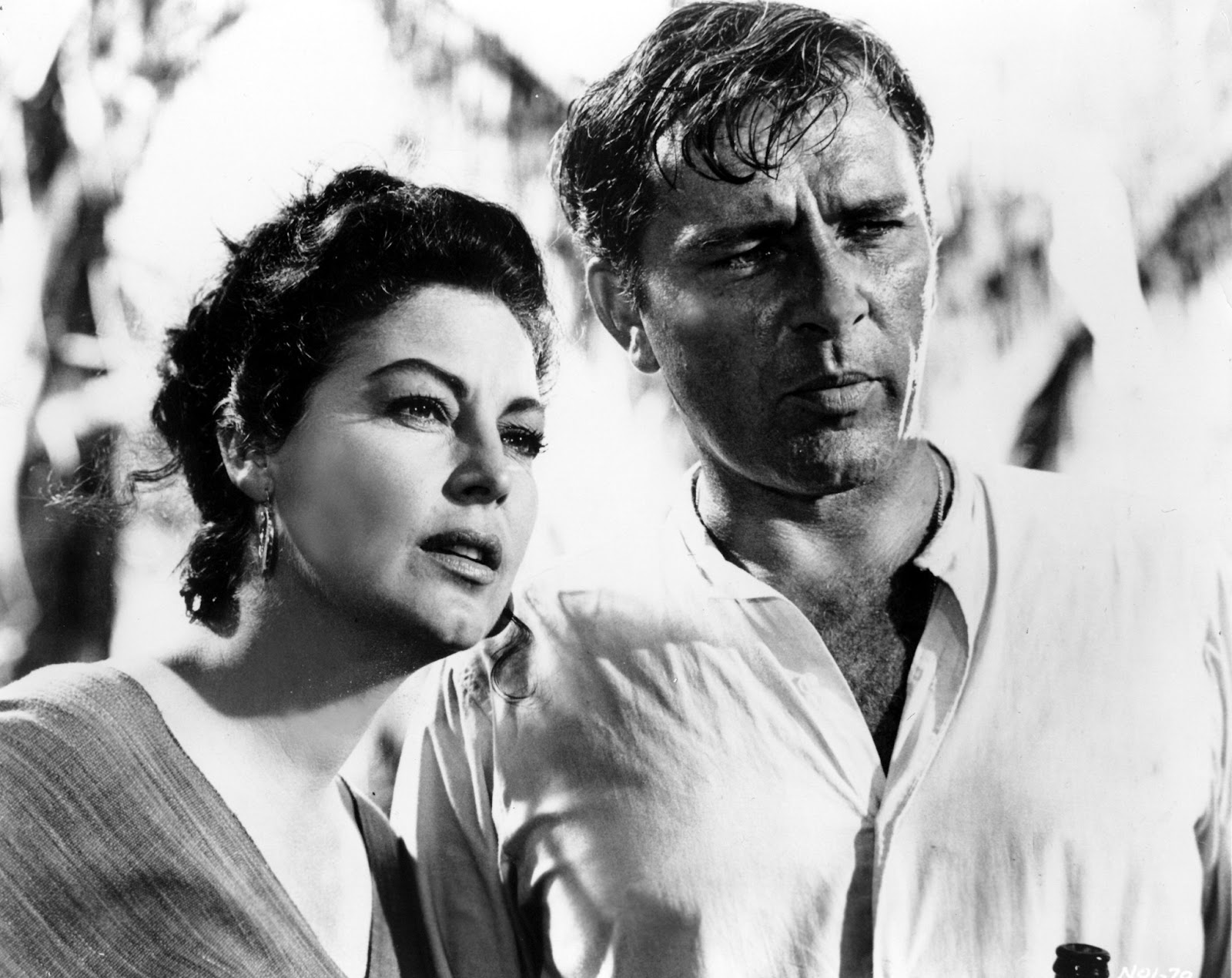
The performance's are excellent, for the most part. Richard Burton gives his character a crazed energy that showcases exactly how good an actor he was. The material is putty in his hands, and he morphs it into a man whom could be deemed disgusting, and who becomes quite relatable. His character is pitiful yet entertaining at the same time, thanks to Burton's talent. Ava Gardener, whom one could deem as past her prime in this film, sparkles with a repressed sadness.

Gardner may have been popular in the 40s and 50s, but here she truly shows that she can act. Her Maxine is similar to Burton's character, she contains a repressed sadness that only bubbles out in the end. However, the true delight of the film for me was Deborah Kerr. I've always thought that Kerr was immensely talented, but here she shows exactly how talented. She never succumbs to being over the top, and dominating the film. Instead the exact opposite occurs. It is only later, when one reflects on the film that Kerr's true brilliance is revealed.

For example, there is one monologue that she gives that takes up about five minutes, but I never got bored. I did not because I kept watching Kerr's face and admiring her talent. it is only on re watching the film that I truly understand what drew me to Kerr's portrayal in the beginning. Sheer brilliance. Also excellent is Grayson Hall as the cloying chaperone, and Cyril Delevanti as the world's oldest poet. However, if there is a weak link in the cast, it is certainly Sue Lyon.

Fresh off her debut in Stanley Kubrick's Lolita, Lyon here does a lot of pouting. And flirting woodenly. Don't get me wrong, she certainly looks the part, but she doesn't act it well. Her line deliveries come off as flat, and uninteresting. She was good in Lolita, but perhaps it was the director that shaped her performance in that film. Here, she is the most boring character, instead of one of the most interesting.

While I do not like Tennessee Williams as a writer, he could certainly write great parts for actors. He was also a quick thinker, apparently. In Huston's autobiography, he states that a scene in the film was coming off flat, and then Williams told him to have Burton knock over a glass bottle, and have him walk over. That little thing immensely helps the film.

The writing is good for the most part, but the story is kind of soapy. Still, if you go with the flow, the end result is quite entertaining. The cinematography is vibrant and although the film feels stagey in some parts, the cinematography elevates it from the stage, and into the jungle's of Mexico. The score is also quite good, especially for a Huston film.

Speaking of Huston, his direction here is vibrant and it feels alive. It feels as if he just recharged his batteries and came out of the gates running. To be fair, it does appear as if Huston directed the film in his normal style, but I can't help feeling entertained. His relaxed direction is confident and it works well. While Huston mainly directed novels, after this film, I'd love to see him do another play.

While, it may be outdated and stagey, this film is still incredibly entertaining and the cast is uniformly terrific.

The Night Of The Iguana,
1964,
Starring: Richard Burton, Ava Gardener and Deborah Kerr,
Directed by John Huston,
8.5/10 (A)

RANKED:
1. The African Queen
2. The Dead
3. The Man Who Would Be King
4. Moby Dick
5. The Asphalt Jungle

6. The Red Badge Of Courage
7. The Night Of The Iguana
8. The Life and Times of Judge Roy Bean
9. The Misfits
10. Beat the Devil

11. Reflections in a Golden Eye
12. Fat City
13. Wise Blood
14. The Treasure of the Sierra Madre
15. The Unforgiven
16. Under The Volcano
17. Heaven Knows, Mr. Allison

18. Annie
19. Prizzi's Honor
20. Phobia: A Descent Into Terror 

Sunday, 27 January 2013

Annie (1982)

THE FILM:
In 1981, John Huston was strapped for cash. He needed a job, no matter what it was. He found one in the form of Annie. Annie was a hugely successful Broadway musical, based off of a 30's comic strip, that Columbia Pictures paid a fortune to acquire. Huston was originally repelled by the story, but he was forced to do it because of his lack of cash. There was a long period of trying to find someone to play Annie, and it took two years before they settled on Aileen Quinn, a spunky 10 year old from Pennsylvania.

In other roles, Albert Finney was asked to shave his head in order to be in the film. The making of the film was boring for Huston, and he had little interest in the final product. In the end, the film was to be one of Huston's most successful pictures, and it gave him enough credit to make his final three films.

THE PLOT:
Little Orphan Annie is a spunky redhead living under the ruthless rule of Ms. Hannigan, who runs the orphanage she lives in. She and the other orphans are forced to toil endlessly under their drunk headmistress. One day, Annie escapes from the orphanage in a laundry basket and meets Sandy, a dog. She and Sandy are caught by the police and returned to the orphanage, where Ms. Hannigan locks them in a closet.

Then, Ms. Farrell shows up on the orphanage doorsteps. She is the billionaire Oliver Warbucks's personal secretary, and they are looking for an orphan to take care of for a week, as a publicity stunt. She sees Annie and is immediately smitten and manages to wrestle her from Ms. Hannigan's control. She brings her to Warbucks's mansion, where the staff falls in love with her. When Warbucks arrives, he isn't too pleased, but he lets her stay. Then when Annie and Sandy stop an assassination attempt on Warbucks, he begins to slowly give in to her charm.

THE CRITICISM:
If what I've written above seems to be gushing with cuteness, imagine it with singing. Yep, this film is very, very cute. But it can get very, very annoying. There is a scene where Annie and Franklin Roosevelt sing to each other. I'm not kidding, that actually happens. To be fair, it could have worked, but only with a director who actually cared about the film. Huston did not. A cute children's musical was the exact opposite of the kind of film's Huston enjoyed to make.

Despite the lively musical numbers, only one song is catchy enough to be memorable, "Tomorrow". The rest are rather forgettable, for example there is a song called "You're Not Fully Dressed Without a Smile." Yep, I'm not kidding. As a musical, the film seems slightly half baked. The dance numbers are well choreographed, but that's about it.

As "Daddy" Warbucks, Albert Finney is pretty good and bald. It's really disconcerting. His head looks like an egg shell. As for his performance, it is a caricature, as most of the performances are. He is good, but it isn't his fault, the character is written like that. Carol Burnett goes way over the top, in a performance that is probably the best in the film. She even has a few funny moments, but a lot of the time her lonely Ms. Hannigan comes off as really creepy, or as a pathetic alcoholic.

Ann Reinking is okay as Ms. Farrell, but her character is rather one note. She does have a good voice though. Tim Curry and Bernadette Peters as a pair of bumbling con men are good, but not great as they too are rather one note. Finally, Aileen Quinn as Annie is very spunky, and lovable, but she overdoes it sometimes, especially when saying "grown up" dialogue.

The screenplay isn't that bad, but it does feel rather wooden. It could have been done much better, as most of the musical could have been. When you have a story this well-worn, it helps to spice it up a little, maybe with interesting direction or a different approach. As it is, the cinematographer shoots it in a rather boring, uninteresting way. It feels very stagey, it comes off as rather boring. To be fair, it can be quite enjoyable at times, but at other times it can be too much, or too little.

The film seems to rely on Annie's charm and cuteness in order to make you root for her. To be fair, she is cute, but it can be overbearing at times. The scenes in the orphanage are not bad, but some of the other orphan's can be really annoying. There is one actress who kept saying "oh my goodness" in such an annoying way, it made me burst out laughing each time. The film also goes on for way too long, but it could have been worse I guess.

Huston's direction is not that good, you can tell it was a money job. His camera seems uninterested, and it drifts through the scenes as if it didn't really want to be there. I have often accused Huston of being laid back, but here he could have been sleeping and it wouldn't make the film worse. To be fair, Huston did have emphysema and would die within five years, but he still could have done a better job.

Overall, the film isn't that bad. It can be enjoyable at times, but it could have been much better. If you are looking for a childish musical, this will do. But still, you could do better.

Annie,
1982,
Starring: Aileen Quinn, Albert Finney and Carol Burnett,
Directed by John Huston,
6/10 (C-)

RANKED:
1. The African Queen
2. The Dead
3. The Man Who Would Be King
4. Moby Dick
5. The Asphalt Jungle

6. The Life and Times of Judge Roy Bean
7. The Misfits
8. Beat the Devil
9. Fat City
10. Wise Blood
11. The Treasure of the Sierra Madre
12. The Unforgiven
13. Under The Volcano
14. Heaven Knows, Mr. Allison

15. Annie
16. Prizzi's Honor
17. Phobia: A Descent Into Terror  


Saturday, 12 January 2013

The African Queen (1951)

THE FILM:
The making of The African Queen is almost as famous as the film itself. John Huston moved his whole cast to the middle of nowhere in Africa, virtually the whole cast caught some sort of tropical disease. Huston was obsessed with killing an elephant. Katherine Hepburn wrote a book on the experience, which I have read. A fictional book has been written on Huston's obsession to kill an elephant, which in turn was made into a movie by Clint Eastwood, which I've seen. 

Bogart and Huston were the only two members of the cast and crew who didn't get dysentery, by drinking nothing but imported scotch. Hepburn, determined to counter their drinking, drank more water than anyone else on set, causing her to get dysentery multiple times. The shooting was hot, and during one of her scenes, Hepburn would vomit in a bucket the minute Huston yelled cut.

I could go on and on about things that occurred on set, but in short, it was close to disaster. Under those conditions, its amazing they made a film at all. But they did.

THE PLOT:
Charlie Allnut is a rascal. He is also a boat captain in Africa, who ferries things up and down the river in 1914. One day he stops at a missionary, where prim Rose Sayer is preaching along with her brother. Charlie has tea with them, but to say they get along is an overstatement. Charlie leaves, but not before telling the English Rose and her brother that Germany has declared war.

Soon after he leaves, the camp is taken over by Germans, who burn the huts down and leave Rose and her brother to fend for them selves. Her brother catches the fever, and dies. It is then that Charlie comes back. He helps Rose bury her brother, and then asks her along to wait out the war in the jungle. Soon after, they find a place to hide, when Rose begins to look at a map.

She asks Charlie why they can't go up the river, and he tells her that there are rapids, a German fort, waterfalls, and at the end, a big German steamer, patrolling the lake so the British can't move down. Noticing Charlie has a lot of explosives, that he was carrying for the mine, Rose asks if they can't  ride to the lake, and then blow up the German steamer. Charlie says no, but Rose persists, and you can see where this is going.

I know it sounds dark, but it is really anything but.

THE CRITICISM:
There is one thing that can impede you from enjoying The African Queen: cyniscm. You cannot look at this film from a cynical point of view. You'll hate it. That said, you can going into it being cynical, but you have to drop it after five minutes. Okay, got it? Good, we can move on. Three films have been called Huston's best: The Maltese Falcon, The Treasure of The Sierra Madre and The African Queen. At least, from what I've heard.

I did not like The Treasure Of The Sierra Madre, and as I have not reviewed The Maltese Falcon, I'll hold judgement until then. So what is Huston's best film? The African Queen, from what I've seen. Many people have tried to describe the essence of this film. Is it Bogart, Hepburn or Huston? Is it the shooting on location? Or maybe the story? I cannot pinpoint the film's greatness. It is like a cozy den, that once you've entered, you never want to leave.

The only other film I've had such a reaction to is Casablanca. It is a great film, but why? The performances by Humphrey Bogart and Katharine Hepburn are certainly part of that magic.You only have to see them on screen for a second, and you are instantly with them. Bogart plays the kind of character only Bogart could play, and likewise with Hepburn. They inhabit their characters with an energy that cannot be defined. You do not think of them as Katharine Hepburn and Humphrey Bogart, but as Rose Sayer and Charlie Allnut.

The characters are that memorable. It is the kind of love story that feels alive and fresh, despite how in a different film it would seem cliched. Here it embraces the cliche, and is better because of it. The development feels like a natural extension of the plot. Speaking of plot, the screenplay by James Agee and John Huston achieves that perfect balance of giving you a plot that keeps you interested, and two leads you cannot help but love.

Agee had a heart attack before he could finish the screenplay, so Huston brought it down to Africa to finish it. He brought Peter Viertel to work on it with him, and sometimes they would write the next scene the day before it was shot. Shooting on an actual river in Africa must have presented a massive challenge for the cinematographer, but he succeeded admirably. The film is neither a walking travel ad, but it doesn't forget about it's landscape either.

Perhaps the only weak link is the score, but even that can not impede the film from greatness. This brings me to Huston's direction. He has often been accused of his films looking staged, with no amazing cinematic tricks employed. I cannot defend him, but I can say this. Huston is a director. He is not an actor's director, a cinematographer's director, or a screenwriters director. He is truly a director, he oversees all aspects of production with the same wise gaze. He is not an auteur. 

He trusts the people he works with to do a good job, and just oversees them doing it. This kind of film making is the only kind that would work for The African Queen. And it does, Huston delivers yet another beautiful adventure film. If you are feeling low, this is the kind of film that can make you feel better. When I gave The Dead ten stars, it took me a while to make the decision. Here it took me a second. The African Queen is an indisputable masterpiece, for now and for always.


The African Queen,
1951,
Starring: Humphrey Bogart, Katharine Hepburn and Robert Morely,
Directed by John Huston,
10/10 (A+)

RANKED:
1. The African Queen
2. The Dead
3. The Man Who Would Be King
4. Moby Dick
5. The Asphalt Jungle
6. The Misfits
7. Beat the Devil
8. Wise Blood
9. The Treasure of the Sierra Madre
10. The Unforgiven
11. Heaven Knows, Mr. Allison
12. Prizzi's Honor
13. Phobia: A Descent Into Terror


Monday, 31 December 2012

Beat the Devil (1953)

THE FILM:
In 1953, Humphrey Bogart was looking to make a film out of the novel Beat the Devil. His wished for his longtime collaborator John Huston to direct the film, but Huston was involved in post-production on his film Moulin Rouge, and was committed to making another film with Katherine Hepburn. Bogart was then forced to go with two-time collaborator Nicolas Ray. However, before the cameras could start rolling, Huston manged to fit the film into his schedule.

The shoot was eventful, shooting on the Amalfi coast in Italy. The script was constantly being rewritten, often the night before shooting, by Huston and Truman Capote. Bogart was involved in a nasty car accident, and his speech ability was made limited. In post-production in England, Huston hired a skilled mimic to dub some of Bogart's lines. His name was Peter Sellers. Beat the Devil would be the last film Huston and Bogart would make together, as Bogart died in 1957.

THE PLOT:
Billy Dannreuther and his wife Maria are in Italy, planning to take a steamer to Africa, with four conniving criminals. They plan to buy land in Africa rich with uranium to exploit, and get rich off of it. When Billy wakes up one day, he finds that a man who had helped them with the plan was mysteriously killed in London. Going downstairs, he meets future fellow passengers, the Chelms; Gwendolen and Harry. Harry seems to be a stuffy Englishman, but his smart, attractive, blond wife is taken with Billy, and he invites them to dinner.

They arrive at the restaurant a confused sort. Gwendolen is smitten with Billy, while Harry doesn't care much for him. On the other hand, Harry is smitten by Billy's seductive wife, Maria. Their steamer is delayed constantly, by a malfunctioning oil tank and a drunk captain. When Billy and one of his four acquaintances watch their car fall over a cliff, they are presumed dead, and one of the criminals lets Harry in on the secret, and Gwendolen confesses her love for Billy.

When Billy and his acquaintance arrive back, everyone is confused, and then they get the call to board the steamer. It only gets more confusing, so I'll save you the trouble.

THE CRITICISM:
When I finished Wise Blood, another Huston film, I was terribly perplexed. On one hand it was a very interesting film,  on the other it left me cold, and confused. I didn't know how to review it, properly at least. I promised myself that if I ever came across a similarly perplexing film, I would think for a while before I wrote a review. When I first heard of this film, I immediately thought I would come across a similar situation. I mean, come on, have you heard the plot! Critically, it is also divisive.

Roger Ebert placed it upon his Great Movies list, a list of the best films of all time, yet it has a 6.6 on IMDb. I was worried I would be overly confused by the plot and turned off by its craziness. What a surprise I found when I finished watching the film, and had  a review already planned in my head.

This film has been called a satire, but a satire of what? I cannot classify this as a satire, so what is it? The answer is very simple, it is an adventure film. I found myself laughing at many points, although it is not a comedy. It is certainly an odd film, yet it is entertaining to say the least and the tricky twists and turns of the plot are actually quite easy to follow.

It seems like the whole cast is having a ball, with Bogart turning in the kind of cynical performance he is the master of. Jennifer Jones is blonde, and loving it. I haven't seen many films with her, so I can't quite judge her quality as an actress, but she is excellent as the devious Gwendolen Chelm. The typical English exterior is betrayed, as she reveals herself to be a scheming little devil with a voracious appetite, for love out side of her marriage.

Peter Lorre, Robert Morely and Edward Underdown are all also excellent. The odd man, or should I say woman, out is Gina Lollobrigida. Her role as Bogart's young, sensuous Italian wife is certainly fine, but she seems to be in the wrong film. This may not be her fault, as it seems as if no one on this movie knew what they were going for. Her performance is a bit one note, which is never good, even in a adventurous romp like this film. To be fair she is never really given any stand out scenes.

The screenplay seems incredibly muddled, yet it works in a very strange way. It seems that even working nights wasn't enough to stop Truman Capote from putting his own spin on the proceedings, and the dialogue is one of the films strengths. Capote and Huston manage to keep the screenplay tight and lean, but some scenes could have been cut, and some are just unnecessary.

This film can be found in the Public Domain, so the transfer isn't of the best quality. The cinematography is fair, but nothing truly stands out. The same can be said of the score, it works, but you don't find yourself humming it later on. The locations are beautiful and they work well for this type of story.

Huston's direction reflects the tone of the story, relaxed, smooth and in control. It flows naturally, showing that Huston wasn't afraid to take it easy, while still remaining in command of his film.

Overall, is it amazing? No, not really. Is it entertaining enough to serve as an enjoyable experience for 90 minutes? Yes, of course. It isn't thought-provoking. It isn't deeply psychological. It is entertaining, fast paced and likeable. So yes, it's not bad.

 Beat the Devil,
1953,
Starring: Humphrey Bogart, Jennifer Jones and Robert Morely.
Directed by John Huston,
7.5/10 (B+)


RANKED:
1. The Dead
2. The Man Who Would Be King
3. Moby Dick
4. The Asphalt Jungle
5. The Misfits
6. Beat the Devil
7. Wise Blood
8. The Treasure of the Sierra Madre
9. Heaven Knows, Mr. Allison
10. Prizzi's Honor


Sunday, 16 December 2012

The Man Who Would Be King (1975)


THE FILM:
In the mid 1950's, John Huston picked up a copy of Rudyard Kipling's The Man Who Would Be King. Huston felt the story would make a great film. He approached both Humphrey Bogart and Clark Gable for the lead roles, and they accepted. Unfortunately, due to Bogart's death in 1957, the project stalled. Interest was regained during the making of The Misfits, when Clark Gable expressed his desire to do the film. Unfortunately, due to Gable's death in 1961, the film was once again shelved.

It would be brought up in conversation now and then, with names like Burt Lancaster and Kirk Douglas attached.  Nothing came of it, and the project was yet again shelved. Finally in 1973, during the making of The Mackintosh Man Huston approached Paul Newman about doing the film, with Robert Redford. Newman thought the film sounded excellent, but if the film was to be about British men, British actors should be cast. Newman mentioned Sean Connery and Michael Caine as possible leads.

Huston thought the idea excellent, and immediately contacted the two. Both agreed, and the shooting commenced in Morocco. It would be the last large scale epic Huston would ever tackle.

THE PLOT:
Rudyard Kipling is the author of a newspaper in Victorian era India, and one night as he types the next day's paper, a figure in rags approaches him. It comes with great shock to him when he realizes that this is a man he had befriended years prior. Indeed, it is Peachy Carnahan, whom Kipling had met when Peachy stole his watch. Carnahan begins to tell the story of his adventures, with fellow rogue Daniel Dravot.

Years earlier, they had the idea to walk to the mystical land of Kafiristan, where no man has been since Alexander. The idea was to make peace with the warring tribes, and set themselves up as kings. After many sidesteps, they reach their destination and kick their plan into action. After Dravot is hit with an arrow, blocked by an ammunition belt, the local populace think him a god. After a great coincidence, he becomes the ruler of the land, and people worship him.

Unfortunately, Dravot begins to think himself an actual god...

THE CRITICISM:
If ever the phrase "they don't make 'em like they used to" is applicable, this is a shining example. This kind of epic, big budget swashbuckling adventure is distinctly old Hollywood, but also incredibly entertaining. The film balances drama with comedy, adventure and greed, and does it flawlessly. This film hits all the right buttons, and then even more. Caine and Connery have tremendous camaraderie and their friendship is one of the most believable of all time.

Indeed, in their performances, they exude a remarkable charm and drama. Caine, as Peachy Carnahan is charming, dangerous and greedy, while the same can be said for Connery's Daniel Dravot. Those who know Connery only as James Bond will be in for a shock when they see this film. He proves that he can not only act, but act well. For those who know Caine as an old man, will be surprised to see that in his youth he was an excellent actor.

Christopher Plummer, in the role of Kipling is absolutely excellent. He is the lens through which you observe the story. The many years, and drafts of the screenplay, definitely show. All of that time in pre-production result in a perfectly realized script, and film. The score, by Maurice Jarre can be too much at points, but is still quite moving, especially in the last scene. The cinematography is beautiful, although it might feel slightly old school at points, so is the film.

Too many epics find that with a big budget, the film must be intense and brooding drama. As Huston realizes here, that is not the case at all. With a big budget, he manages to craft an excellent, drama that doesn't mind verging on the comic at points. This is but one of the many literary adaptations Huston would tackle throughout his long career. As is the case with almost all of those films, I have not read the source material. From my understanding Rudyard Kipling was an actual British writer, who at one point did live in India.

I am once again bring light on Huston's direction. He brings a masterful touch to the proceedings, crafting what could even be considered satirical by some. The film comes together through his direction, and indeed I cannot think of many directors whose range extends as far as Huston. If there was ever a running theme throughout his films, it is greed. This is no exception.

As I wrap up, I call attention to the last scene of the film. To those who have seen it, and those who haven't, I believe you might be able to sympathize with me when I call attention to the incredibly moving nature of the ending. The singing was an incredibly sad and fitting end to this, one of the greatest epics ever made.

I considered putting this film as my number one Huston, but I couldn't bring myself to remove The Dead from that position, so at least for now, this film will have to be content with second place.

The Man Who Would Be King,
1975,
Starring: Michael Caine, Sean Connery and Christopher Plummer,
Directed by John Huston,
10/10 (A+)

RANKED:
1. The Dead
2. The Man Who Would Be King
3. Moby Dick
4. The Asphalt Jungle
5. The Misfits
6. Wise Blood
7. The Treasure of the Sierra Madre
8. Heaven Knows, Mr. Allison
9. Prizzi's Honor


Monday, 10 December 2012

Prizzi's Honor (1985)

THE FILM:

John Huston is in his late 70s. He isn't what you'd normally call hot stuff. Richard Condon wrote a book about the mob, it was a comedy. Condon decided he would make his story into a film, so he approached Huston, despite Huston not having made a comedy in some time. Huston went through an impressive roll call of names for the various parts, but he made his mind up in the end with Jack Nicholson playing Brooklyn mobster Charley and Kathleen Turner playing the seductive Irene.

Huston even cast his daughter Anjelica in the juicy part of Maerose. The film was not expected to perform well, but it became such a massive sleeper hit that when it came out on VHS, it was still in theatres. Critics loved it, and  it nabbed Huston his last Oscar nomination for Best Director, at the young age of 78, a record that stands even today. So it would make sense for this film to be regarded as a classic these days, right?

Wrong.

THE PLOT:
Charley Partanna is born into the mafia, so when he becomes of age he becomes a contract killer for the Prizzi's, one of the most famous of the New York mafia families. At a family wedding, he notices the beautiful Irene Walker. He is immediately smitten, but he loses her and can't find her. Afterwards he gets a call from her, she's in California and she wants to meet him. The next day Charley flies out and they fall immediately in love, and so does she.

He flies back home bursting with happiness, and he gets an assignment. Someone stole money from the Prizzi's casino in Vegas, and they aren't happy. It was a husband and wife job, apparently and they are in California, so Charley flies back out. There he shoots the husband, and then waits for the wife to come home. The wife is Irene, and she gives him the money, only there is half of it missing. In doubt over weather to kill or kiss her, Charley flies back to New York (again), and consults his former fiancee, after they have sex on the carpet.

Charley decides to kiss her, and flies (seriously, they use the same airplane each time, it's really annoying) back to California and marries Irene. From there, the newlyweds go back to New York (guess the method of transportation) and begin to work on a new job. It turns out that Irene is a contract killer and she and Charley plan to kidnap a bank manager for ransom, only they are forced to shoot a cops wife, turns everyone against them, even each other.

THE CRITICISM:
 I really wanted to like this movie, but I think you can tell by my annoyance over the constant air travel (seriously, it's like an ad for United) that I didn't love this film. I didn't hate it though, because Nicholson is just so entertaining while trying to pull off a Brooklyn accent, though it almost works. It is a black comedy, but I did not laugh once or cringe. I sat there and saw the movie.

Above, I wrote that this film has mostly been forgotten, and that is true. it was apparently a big hit in the 80s and I can see why. But it has been partially forgotten. Maybe because 1985 was such a weak year for film, this was regarded as good enough. Nicholson looks a little old, but he and Turner had sufficient box office appeal to pull it off. I had been told that this film was amazing and really bad. Personally I did not enjoy it, but it was entertaining enough.

With the performances, Nicholson is so completely over the top that his Charley Partanna almost works, the accent is enough to make me smile, but unfortunately for a two hour long film, a smile is not enough. Kathleen Turner certainly has an abundance of sex appeal, but I found Irene to be incredibly similar to Turner's work in the outstanding Body Heat. She had me confused about whether she was a hero or villain, up until the last few minutes I did not know. Some would sat this helped the performance, but I personally just found it confusing.

Anjelica Huston won an Oscar for her work as Maerose Prizzi, but like I said above, it must have been a weak year. Huston was good, but again I couldn't figure out weather she was good or evil. It just ended up confusing me. The rest of the cast does good work, but nothing jumps out. The cinematography can feel rather old school at some parts, but I guess that's just the way Huston interpreted the story. Alex North's score can feel clawing at some points, but the covers of popular Italian music can be entertaining.

I felt as if the film was Huston taking a break. It certainly didn't feature any amazing shots or scenes, I cannot comprehend the film's multiple Oscar nominations, it seems to me like a really average film. That is not to say that it wasn't entertaining, Nicholson was enough to save the film from mediocrity. The end result is not the boring film it might have been without Nicholson's presence and Anjelica certainly injects life into her scenes, but in the end, despite the wicked satire of the plot the film never really goes anywhere you want it to and you are left feeling empty.

But I guess that's better than nothing.

Prizzi's Honor,
1985,
Starring: Jack Nicholson, Kathleen Turner and Anjelica Huston.
Directed by John Huston,
6/10 (C-)

RANKED:
1. The Dead
2. Moby Dick
3. The Asphalt Jungle
4. The Misfits
5. Wise Blood
6. The Treasure of the Sierra Madre
7. Heaven Knows, Mr. Allison
8. Prizzi's Honor